
Opinion
Nigerian Government’s Proclivity with Loans, Finds Wings with COVID-19
By Vivian Bellonwu
Nigeria’s hitherto precarious economic state appear to be in for an unmitigated meltdown as the present Coronavirus pandemic has exposed and is bringing to the fore, both the weak nature of the nation’s economic fundamentals as well as the deficient capacity of its managers and management.

Following the COVID-19 pandemic outbreak and the hit it is giving to the economy, government’s first and seemingly singular response, has been simply to borrow. From an eight hundred and fifty billion naira credit approved by the country’s senate to a staggering $3.4billion loan from the International Monetary Fund, IMF, both the Central bank of Nigeria and the ministry of finance has talked of plans to embark on a borrowing spree, from local and foreign sources to according to them, fund the nation’s budget.
The Minister for finance only last week, hinted that the World Bank would be borrowing Nigeria (and some other African countries), $510bn between 2021 to 2023.
The Nigerian government’s rapacious appetite for loans and borrowing is well known, and the COVIS-19 pandemic appears to present it with a plausible pedestal to ventilate this proclivity. It is on records that even with a weighty debt overhang of $84billion as at December, 2019, government earlier this year, sent a request to the national assembly to borrow a cocktail of loans amounting to a stunning $22.7bn mainly from China, and the World bank. Nigeria currently struggles with its national budget and this is largely because debt servicing consumes a huge percentage of the resources earmarked for national development.
Part of the worry stems from the fact that Nigeria’s history with loans, both with its judicious use as well as conditionalities have been appalling; while endemic corruption has rendered all loans borrowed for infrastructure and development purposes ineffectual, the country has had to both live with and bear the brunt of the many harsh conditionalities that come with the loans. Already, with the latest loan of $3.4bn advanced to the country by IMF, the body has hinted at the devaluation of the Naira. This is tragic, even as it is very much in the nature and manner of IMF loans (and its conditionalities), which largely strangulate, wane and in some cases kill economies of developing countries, while overseeing the hoisting of neo-liberal policies that go to promote unmitigated inflation, job losses, mass poverty and unbridled dependency. some African countries with smart governments such as Tanzania rightly recognizes the booby trap these loans represent and only recently its president roundly rejected a $10bn Chinese loan offer outrightly calling the conditions attached to it “madness”.
Nigerian government must refrain from this proclivity with quick-money, in the forms of loans, credits, etc, for beneath it is carefully tucked away tragic conditions, and usually, effectively hidden from the citizens cum public.
The Speaker of the House of Representatives, Hon. Femi Gbajabiamila, has rightly pointed out during his speech on March 2020, at the resumption of House plenary, from the COVID-19 break, that this is the time for the country to re-invent itself by doing things differently, and taking those steps and actions that will re-set the country onto the trajectory of real development. This call is germane.
The Nigerian government has received robust support systems since the outbreak of the pandemic to warrant recluse to such sleaze of borrowings; Nigeria has been granted debt relief by the G-20 nations and the world bank, it has also received huge sums of money from abroad at home running into trillions of Naira, to support the country mitigate the impact of the pandemic, that if properly planned, channeled and utilized, would meet the country’s needs. Anything to the contrary can inarguably be seen to be propelled by corruption, greed and appetite to embezzle. The debt relief should free up funds/resources to fund the budget and invest in developmental projects and programs, while the donated funds provide resources to further address the COVID-19 impacts.
The present administration must do all it can to refrain from leaving behind a legacy of debt and plunging Nigerians into generational debt-enslavement and repayment, enslavement to foreign elements, poverty and unmitigated hardship.
Vivian Bellnwu (Mrs), writes from Social Action, Nigeria, FCT, Abuja.







Opinion
The UN Hypocritic, Irresponsible Walkout Of Shame: And Nigeria’s Terrorism at Home
By H. E. Mejeh
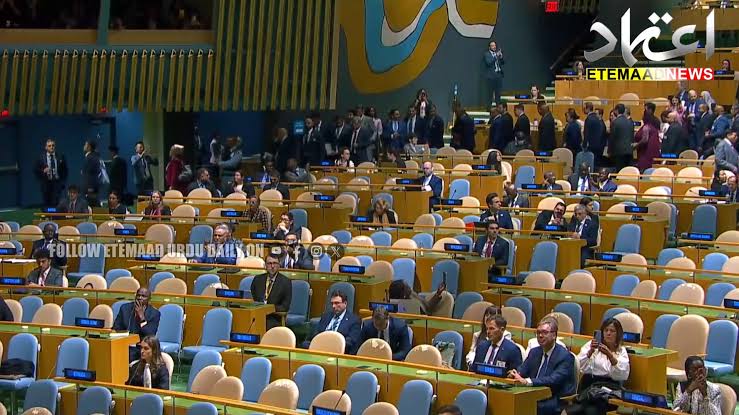
Yesterday in New York, Nigerian delegates staged a well-rehearsed walkout from the United Nations General Assembly as Israeli Prime Minister, Benjamin Netanyahu, took the podium. adsbygoogle || []).push({});
Dozens of delegates left the hall in protest of Israel’s war in Gaza and Lebanon. Netanyahu, unfazed, called them “moral cowards” and continued his speech.
It was a powerful scene for international cameras. But for any Nigerian watching at home, it was a scene of profound irresponsibility and hypocrisy.
Our government is very good at performing morality abroad, while abdicating its primary duty at home.
What moral standing do we have to walk out on terrorism?
Israel says it is fighting terrorism – Hamas, Hezbollah, Iran. You may agree or disagree with its methods. But its government leaves no doubt that it will defend its citizens at all costs. Netanyahu told the UN that attacking Iran “was one of the easiest decisions I’ve ever had to make” because the security of his people was non-negotiable.
What is Nigeria’s doctrine on terrorism?
For over 15 years, Boko Haram, ISWAP, bandits, and kidnappers have turned the North-East, North-West, and North-Central into killing fields. Thousands of our citizens have been slaughtered, our schoolgirls abducted, our farmers displaced, our soldiers ambushed, killed. Yet the response of the Nigerian government has been press releases, committees, and condolence messages.
We walk out against alleged genocide in Gaza, but we have normalized genocide in Benue, in Plateau, in Southern Kaduna, in Zamfara, in Borno. A government that cannot protect its own people has no business performing outrage on the world stage.
The Lackadaisical War
1.No Clear Ideology: Israel has defined its enemy. Nigeria still calls terrorists “bandits,” “gunmen,” and “unknown gunmen,” as if naming them correctly would be too offensive.
2.No Accountability: When terrorists kill 40 citizens in a village, no security chief loses his job. When a school is attacked, no minister resigns. Failure is rewarded with tenure extension.
3.No Justice: Terror suspects are “repented” and reintegrated with stipends, while their victims rot in IDP camps without justice or compensation.
Which serious nation fights terrorism this way?
Our delegates can afford to fly Business Class to New York to walk out on Israel, but our soldiers in the trenches cannot afford basic drones, night-vision goggles, and timely air support.
The Truth
You cannot fight foreign injustice while you pamper domestic terror.
That UN walkout was not foreign policy. It was a distraction. A government that is failing to secure lives and property at home is trying to buy cheap moral credit abroad.
If our government had the same energy it used to walk out on Netanyahu to walk into Sambisa Forest, into the bandit camps of Zamfara, into the killer herdsmen hideouts in Benue, Nigeria would be safer today.
Charity begins at home. Security begins at home. Leadership begins at home.
Until we defeat the terrorists in Nigeria, we have no moral right to lecture any nation on how it defeats its own.
H. E. Mejeh Esq.
Lawyer with Conscience, Nurtured by Truth.
Opinion
Rep Members Do Not Sell Contracts: Boniface Adie Must Cease the Barefaced Lies Against Hon. Peter Akpanke
By Clement Abuo
Marcus Tullius Cicero (106–43 BCE), the renowned Roman orator, lawyer, statesman, and philosopher, once observed that “as fire, when thrown into water, is cooled and extinguished, so also a false accusation, when brought against a man of pure and holy character, boils over, dissipates, and vanishes.
js">
”
This timeless reflection aptly captures the nature of the unfounded and misleading allegations recently made against Hon. Peter Akpanke. Lies, no matter how loudly proclaimed or persistently repeated, cannot outweigh truth, integrity, and a record of noble character.
It is therefore unsurprising that the accusations leveled against Hon. Peter Akpanke collapsed under the slightest scrutiny. No reasonable or fair-minded individual can take seriously allegations coming from a man who openly admits to fraudulent conduct and then paradoxically turns around to claim victimhood.
Such contradictions strip the accusations of credibility from the outset.
To state the facts clearly and unequivocally, members of the House of Representatives—just like their counterparts in the Senate—do not sell contracts. They do not own contracts, they do not bid for contracts, and they do not execute contracts. Their constitutional role is limited to nominating constituency projects, after which the relevant ministries, departments, and agencies handle procurement and execution in line with established procedures. Any claim suggesting otherwise is either born out of ignorance or driven by deliberate malice.
Against this backdrop, one is compelled to question the motive behind Boniface Adie’s hurried dash to the public space with such poorly constructed allegations. He openly admitted to giving out money to “buy” contracts, without pausing to consider the legal, moral, and logical implications of such a claim. How does one admit to an act of corruption and then expect public sympathy? More importantly, how does one claim to buy what does not exist in the custody of a legislator?
Boniface Adie further attempted to emotionally blackmail the public by dragging Hon. Peter Akpanke into his family matter, citing the illness and eventual death of his brother. He admitted that Hon. Akpanke showed concern and reached out, yet he argued that the Honourable Member was obligated to shoulder the entire medical expenses simply because he represents the constituency. This line of reasoning is not only illogical but also reveals a gross misunderstanding of the responsibilities of a lawmaker.
A member of the House of Representatives cannot possibly attend to every personal challenge faced by constituents while simultaneously performing legislative duties—participating in debates, sponsoring bills, raising motions, and advocating for infrastructure and development. Such expectations are unrealistic and, frankly, unreasonable.
Despite this, Hon. Peter Akpanke has consistently gone beyond the limits of his constitutional mandate. He has organized general health outreaches across his constituency, offering free medical services to individuals facing serious health challenges and who cannot afford even basic check-ups.
Those requiring treatment have received care, while others in need of medication support have been assisted financially. These humanitarian gestures, though not required by law, have been undertaken voluntarily and with genuine compassion.
It is therefore deeply uncharitable and misleading to suggest that Hon. Peter Akpanke must personally shoulder every hardship faced by every constituent.
In what can only be described as desperation, Boniface Adie went as far as urging a television station, during a live broadcast, to call the wife of Hon. Peter Akpanke to explain an alleged contractual transaction. One must ask: since when do contractual dealings between two consenting adults require spousal interrogation—especially on live television?
This action exposes the extent to which sensationalism and blackmail were being prioritized over truth and ethics.
Boniface Adie attempted to justify this reckless behavior by claiming that Hon. Peter Akpanke was unreachable. This claim is disingenuous, as he was fully aware of the Honourable Member’s office address and had, by his own admission, contacted him repeatedly, sometimes through his aide.
The decision by the television station to proceed with the broadcast despite knowing that Hon. Akpanke was unavailable raises serious ethical questions. Should Hon. Akpanke later establish his innocence conclusively, how does one undo the reputational damage caused by such premature and one-sided accusations?
Equally troubling is Boniface Adie’s claim that he was approached to buy contracts to fund his election after a failed attempt to become a local government chairman. According to him, this approach was made by someone he identified as “Charlie Emeji,” allegedly an aide to Hon. Peter Akpanke. However, there is no individual by that name serving as an aide to Hon. Akpanke. This fact alone casts significant doubt on the authenticity of the entire story.
Furthermore, Boniface Adie admitted that the so-called meeting took place without the presence of Hon. Peter Akpanke. If that is the case, then it is only logical to conclude that impersonation with the intent to extort may have occurred. Anyone can claim to be an aide to a public office holder, especially when such impersonation serves personal gain.
Boniface Adie must therefore clarify his contradictory claims.
In one instance, he said he paid money to buy contracts; in another, he said the money was meant to facilitate contracts. Both claims are mutually inconsistent and unsupported by verifiable evidence. As already established, members of the House of Representatives do not own contracts and cannot sell or facilitate what is not within their authority.
It would have been more prudent to allow room for peaceful and amicable resolution of any perceived grievance, rather than embarking on a smear campaign fueled by speculation, inconsistencies, and political undertones.
As elections approach, it is not unusual for political opponents to clutch at straws in their bid to discredit perceived threats. Unfortunately, individuals of weak judgment often allow themselves to be used as tools for such schemes, lending their voices to narratives designed to mislead the public.
Hon. Peter Akpanke remains a dedicated, diligent, and hardworking representative of the Obudu/Bekwara/Akamkpa (OBA) Federal Constituency. He has consistently raised motions in the House and advocated policies aimed at improving the welfare of his people. His constituents continue to express satisfaction with his representation.
He has executed numerous constituency projects geared toward transforming infrastructure and improving living standards across OBA. In the education sector, he has supported students through scholarships, sponsorship of JAMB forms, renovation of classrooms, and other impactful interventions.
It is only fair and reasonable to allow Hon. Peter Akpanke to continue the work for which the people entrusted him with their mandate.
Boniface Adie must therefore desist from being used as a cheap instrument of blackmail by political actors nursing failed ambitions and plotting toward 2027.
Clement Abuo is an Abuja-based public affairs analyst and commentator. He can be reached at clemabuo@gmail.com.
Opinion
LIES VS FACTS: Revisiting The Aregbesola Years In Osun

By Gbenga Shaba
Public debates about Rauf Aregbesola’s time as Osun governor often swing between praise and criticism, but many arguments overlook the economic realities of that period. The nationwide recession from 2014 to 2016 hit state finances hard, with 23 states unable to pay salaries at all.
adsbygoogle || []).push({});
Osun faced a sharp drop in federal allocation and internally generated revenue, forcing difficult decisions.
One of the biggest misconceptions is that Aregbesola intentionally paid half salaries. In reality, the Labour Government Salary Apportionment Committee, which was made up of labour leaders and government officials, jointly agreed on a temporary modulated payment structure to prevent mass layoffs. Throughout the recession, over 70 percent of workers (junior staff, teachers, health workers and local government employees) continued receiving full salaries and pensions. The modulation applied mainly to senior officers and political appointees.
Another widespread falsehood is that Aregbesola’s successor, Gboyega Oyetola, inherited the salary modulation. Records show this is untrue. A few outstanding balances of the modulated salaries were already cleared before Aregbesola handed over, and full salary payment had resumed eight months before the end of his administration.
Beyond the salary debate, Osun continued major development programmes. The School Feeding initiative served 254,000 pupils daily and later became a national policy. Thousands of classrooms were constructed or rebuilt, the OYES youth programme absorbed unemployed youths, and road projects continued across the state despite the financial strain.
It is true that the recession created emotional and financial pain for many families, and their feelings are valid. But emotions cannot replace verified facts. Transparency was maintained throughout the crisis, and Aregbesola’s strong grassroots support today reflects public recognition of his long term developmental impact.
The Aregbesola years were a mix of economic challenges and visible transformation. Narratives based on half truths may trend online, but they cannot erase the documented reforms, infrastructural investments and social programmes that reshaped Osun during one of Nigeria’s toughest economic periods.
-
 Entertainments4 years ago
Nollywood Produces 541 Movies in 2022 First Quarter – NFVCB
-
 News7 years ago
I will Maintain High Decorum – Hon Monguno
-
 News5 years ago
2021 Ethics And Integrity Compliance Scorecard Of MDAs: ICPC Scores Censors Board High
-

 Business and Economy4 years ago
Non-interest TAJBank Reports 433% PBT in 2021 Financial Year
-
 Entertainments7 years ago
Censors Board Trains, Gives Grant to 100 Youths in Nasarawa State
-
 News4 years ago
ICDA North Central: Prince Oruma Sues for Igala Unity
-
 AWF7 years ago
AWF to Feature Adedokun, Kawu and Okah-Donli for April Guest Writer Session
-
 News3 years ago
Full List of The New Ministers and Their Portfolio