
General News
DNA of Jonathan, 194, World’s Oldest Animal Reveals Aging Surprise–Scientists Studying Aging
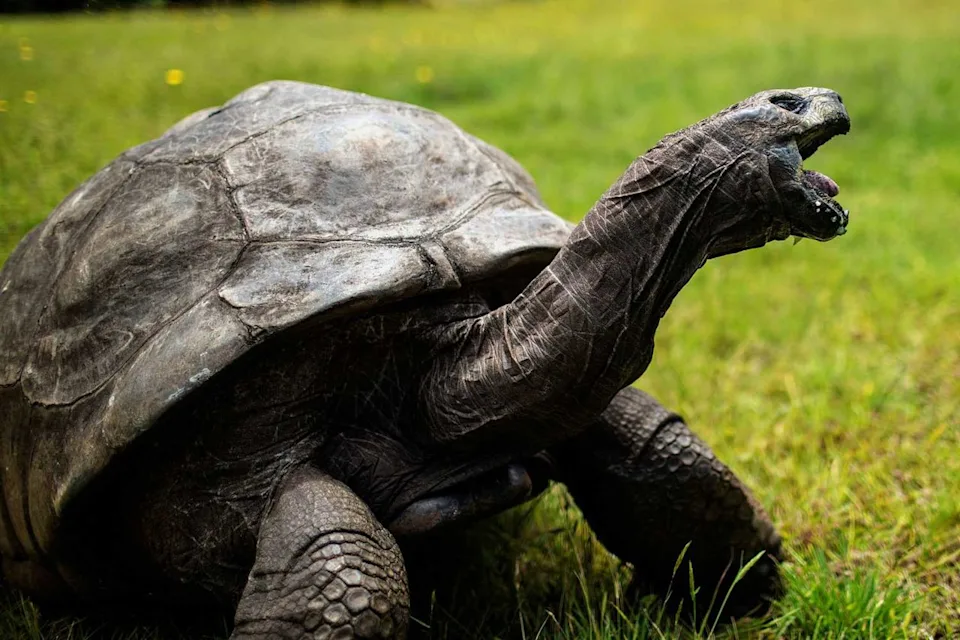
A new look at the genes of Jonathan, who is considered to be the world’s oldest known land animal, reveals interesting insights about longevity
Bailey Richards
At 194, Jonathan the tortoise is considered the world’s oldest tortoise, as well as the oldest known land animal
Scientists found parts of his DNA resemble those of a tortoise more than a century younger, according to new research
Researchers hope his genetic patterns could offer new insights into longevity in animals and humans
Scientists studying aging have uncovered an interesting tidbit from the DNA of the world’s oldest tortoise.

Despite a death hoax that garnered international attention before it was disproven earlier this year, the tortoise, named Jonathan, estimated to be 194 years old, is still standing. He struggles with age-related health problems like sight loss due to cataracts, but remains largely healthy, according to ZME Science. On Friday, Oct. 9, the outlet reported that scientists have learned something new by studying the reptile’s DNA.
A recent genetic analysis of Jonathan, who is also considered the world’s oldest known land animal, has revealed potential clues, “molecular signs of aging,” suggesting a potential clue into human longevity. The record-holding reptile — who lives on Saint Helena, a remote island off the coast of Africa — is an Aldabra giant tortoise. Though this breed of tortoise can typically live up to 150 years old, per the Smithsonian, Jonathan is still an extreme example of the subspecies’ estimated lifespan.
“There are few creatures that could tell us more about aging than the giant tortoises of the Galapagos and Seychelles islands,” Justin Gerlach, a biology fellow at the University of Cambridge who co-authored the new research, told ZME Science.
In other words, Jonathan was the perfect subject for a team of researchers studying longevity from the University of Cambridge, Vanderbilt University Medical Center and other institutions. Through DNA analysis of the reptile, the researchers, according to ZME Science, discovered that while some regions of the elderly animal’s DNA showed signs of aging, others are as similar to those found in tortoises over a century younger than him.
Researchers collected DNA from Jonathan — scraping samples from the cheek rather than drawing blood, which could have endangered him — and compared the findings with those of four other Aldabra giant tortoises of varying ages, the youngest being 5 years old.
DNA methylation patterns, which encode critical biological information, often become less consistent with age, and scientists measure the irregularity and loss of organization through methylation entropy.
Through the new research, the scientists found that certain regions of Jonathan’s DNA retained exceptionally low methylation entropy, according to ZME Science. In certain instances, Jonathan’s DNA in these regions even showed patterns mirroring those observed in the study’s 5-year-old tortoise, the outlet reported.