Health and Life Style
2025 World Polio Day: WHO raises alarm over 54% drop in virus detections in Africa
By Wumi Tewogbade, Abuja
The World Health Organization (WHO), on Thursday, October 23rd, 2025 raised alarm over 54% drop in virus detection in Africa.
This was revealed by WHO Regional Director for Africa, Dr Mohamed Janabi, Message in commemoration of 2025 World Polio Day, in Abuja.

He lamented that two countries in Africa reported type 1 cases, 14 countries type 2 and 3.
He said, “These collective efforts are showing results. Comparing the number of African countries with active
type 2 poliovirus outbreaks between 2024 and 2025 (as of October) declined from 24 to 14, and total
virus detections dropped by 54%. Two countries reported type 1 cases, 14 countries type 2 and 3
reported type 3 based on data as of October, 2025.
“In May 2025, Madagascar officially declared the end of its circulating variant poliovirus type 1
outbreak after comprehensive response measures and sustained surveillance.
eProgress is being sustained by stronger systems. By mid-2025, 11 WHO-supported laboratories had
expanded genomic sequencing capacity, while six began piloting advanced techniques. Notably,
Uganda’s Sanger facility was accredited early this year, improving detection and variant tracking.
Environmental surveillance has also expanded significantly. Today, 98% of countries in the WHO
African Region have systems to monitor wastewater and sewage for polioviruses, providing early
warnings of possible transmission, and enabling rapid response before the virus spreads”.
He noted that the decline in routine immunization coverage, is due to interruptions to vaccination
campaigns, insecurity and vaccine hesitancy continue to pose risks.
“To truly end polio, countries must sustain cross-border coordination, reach zero-dose and under-immunized children, expand surveillance and sequencing capacity, and maintain high-quality outbreak response.
Ending polio in Africa is about more than halting transmission. It means strengthening the systems,
workforce and networks that sustain immunization, outbreak preparedness and resilient health
services. The task ahead demands continued commitment, adequate financing and coordinated
action at every level.
The last mile is always the hardest, but it is also the most important”, he said.
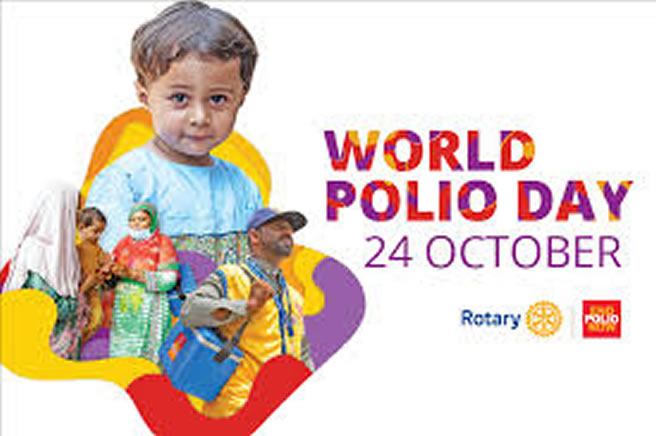
The theme for this year is, ‘End Polio: Every Child, Every Vaccine, Everywhere, is a call to ensure that
no child, in any setting, is left unprotected’.
He therefore taaked, “On this World Polio Day, let us renew our determination to reach every child, with every vaccine, everywhere – and to consign polio to history, forever.
“Between January and October 2025, 15 African countries reached nearly 200 million children with at
least one dose of polio vaccine through supplementary immunization rounds. Thirteen countries
mounted synchronized campaigns, including in highly challenging contexts. In the Horn of Africa,
Djibouti, Ethiopia, Kenya and Somalia jointly vaccinated more than 18 million children in two
consecutive rounds, demonstrating the impact of regional collaboration.
“In the Lake Chad Basin and Sahel, cross-border synchronization has been key to reaching children in
border communities. In April 2025, Ministers of Health launched a coordinated campaign to protect
83 million children across the sub-region”.
He however noted that 98% of countries in the WHO African Region have systems to monitor wastewater and sewage for polioviruses, providing early warnings of possible transmission, and enabling rapid response before the virus spreads.
He noted that digital innovation is improving how frontline teams are supported and how data is used.
“More than 850 000 frontline workers across the region receive digital payments through mobile-money
platforms, with 95% paid within 10 days of campaign completion. This has enhanced accountability
and timeliness, especially in remote areas. Geospatial mapping by the WHO AFRO GIS Centre haalso helped countries locate and reach children in previously missed populations, including nomadic
and border communities”, he said.